
Saying "No" To Commercial Surrogacy

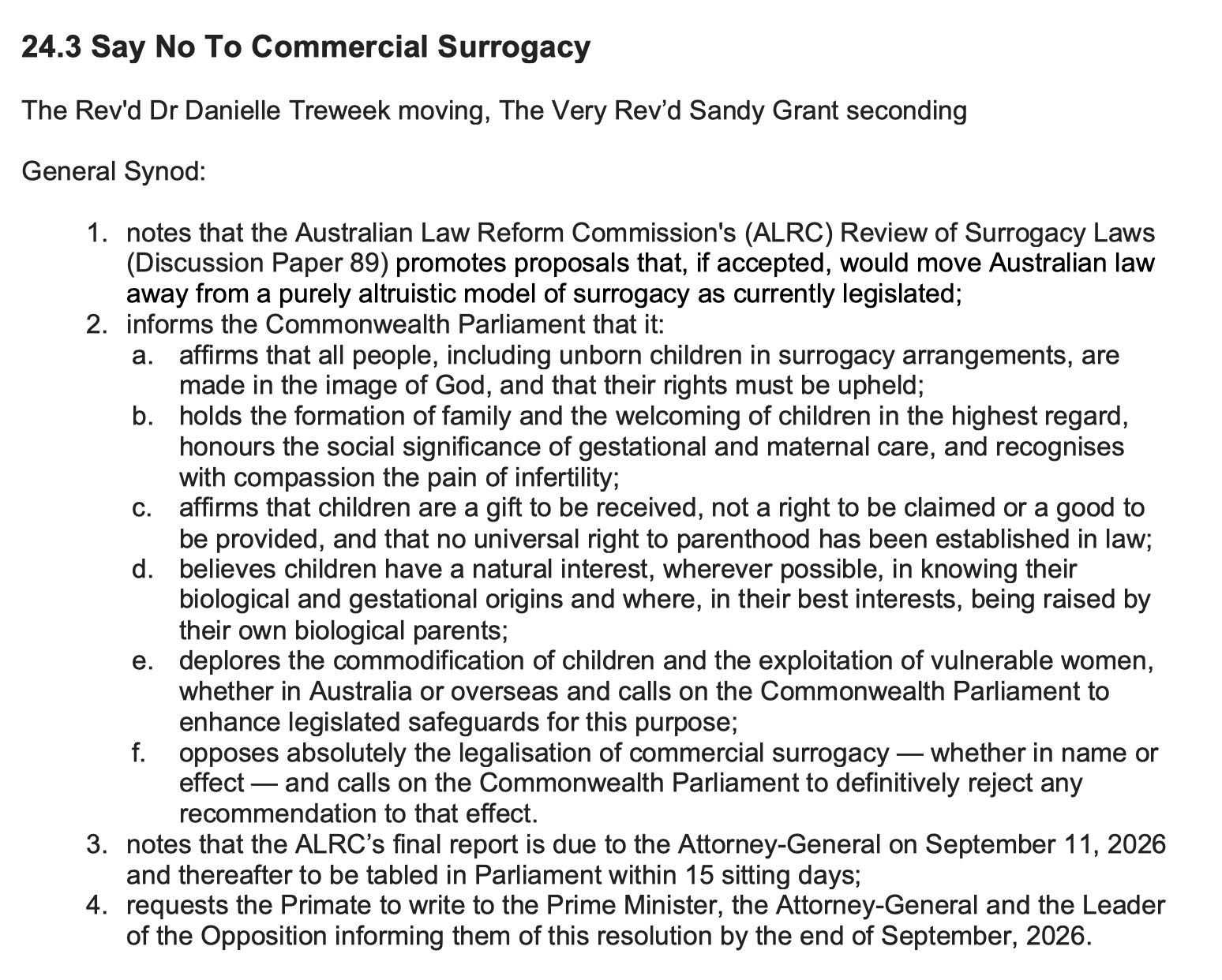
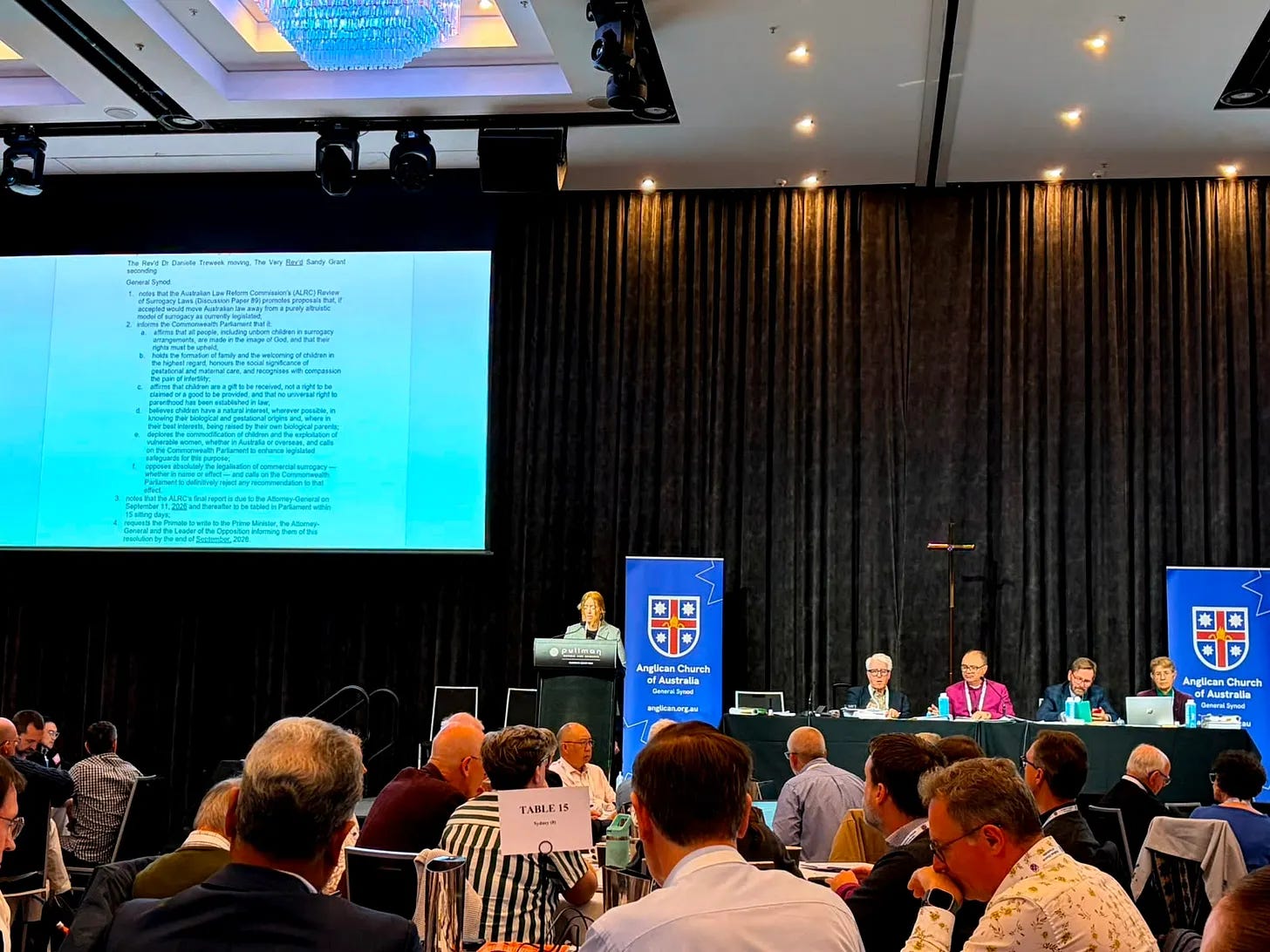
Last week, at the Anglican Church of Australia’s General Synod (i.e., the denomination’s national parliament that meets once every four years), I moved a motion titled ‘Say No to Commercial Surrogacy’. You’ll find the text of the motion itself at the end of this post.
The matter of surrogacy is not something I had much interest in or awareness of until about 18 months ago. But then, in 2025, some State and Federal legislative developments required me to get up to speed on the topic in my role as the Sydney Anglican Diocesan Research Officer. Since then, I’ve been involved in drafting multiple submissions to various government reviews and inquiries, and even testified at a State parliamentary hearing. The topic of surrogacy—and particularly foreshadowed proposals to legalise commercial surrogacy in Australia—has become a matter of great ethical import to me.
It is both impossible and ill-advised for all Christians to feel passionately about all ethical issues at all times. And yet, I do think it is valuable for us to become informed about some of the most pressing ones. And frankly, the commodification of children and exploitation of women that is intrinsic to commercial surrogacy—serving, as it does the interests of big fertility, their shareholders, unscrupulous actors and, in the worst cases, human traffickers—seems rather pressing to me. As does the ever-escalating fragmentation of God’s design for marriage, sex, procreation and childraising that is relentlessly promoted by the artificial reproductive technology industry.
And so, below you’ll find a (slightly modified for format) version of the speech I gave on Friday 14 August, 2026, when I asked the General Synod of the Anglican Church of Australia not only to say “No” to commercial surrogacy, but to ask our government to unambigiously do the same. It was not a speech that said everything there is to say (I only had ten minutes!). But in it, I did attempt to say some of the important things that ought to be said.
I am profoundly thankful that the Synod enthusiastically said “Yes” to “Saying No to Commercial Surrogacy” and consider it a privilege that this resolution now stands in my and the seconder’s name.
(And if, by the end of reading it, you too want to say “No” to commercial surrogacy, then watch this space—especially if you are Australian—because with the forthcoming submission of the ALRC report—read on—there is likely to be not only real opportunity but also real need for many of us to do so.)
Some Context to Saying “No”
Mr President, members of Synod, I am very aware that this motion touches on some of the deepest longings of the human heart; the desire for a child, the desire to be a parent, and the grief felt by many for whom those desires remain unmet. I have walked alongside people I know and love in their grief. But as one who does not have a child who calls me their “mum”, I also know that grief personally.
And so, I do not bring this motion lightly. And yet, I do bring it as a matter of urgency.
First, some context:
In Australia, every state and territory has in place legislation which permits altruistic surrogacy and which criminalises commercial surrogacy.
Commercial surrogacy is defined as surrogacy that involves financial or other material benefit, reward, or advantage above and beyond reimbursement for direct costs. And so, in every Australian state and territory, it is illegal to pay a surrogate mother for any part of her role in or contribution to gestating a baby.
Altruistic surrogacy, which is legal in every state and territory, permits reimbursement to be paid to the surrogate mother for direct expenses she incurs as part of her pregnancy, for example, her medical costs. But it explicitly prohibits any other form of payment, reward, compensation or material advantage.
The distinction between altruistic and commercial surrogacy in Australian law is clear and meaningful.

The Australian Law Reform Commission (the ALRC)—an independent statutory body that reviews Commonwealth law at the Attorney-General’s request—has spent more than a year conducting a review of Australia’s Surrogacy Laws.
The Attorney-General’s terms of reference particularly asked the ALRC to consider “how to reduce barriers to domestic altruistic surrogacy arrangements in Australia” (emphasis added). However, in its June 2025 Issues Paper, the ALRC summarised its task simply as “reducing barriers to surrogacy” (p.1, Issues Paper).
Then, in its November 2025 Discussion Paper, the ALRC dismantled the distinction between altruistic and commercial surrogacy altogether. Indeed, it suggested that any distinction between them is “problematic”, “unhelpful” and even a “fiction of law” (p.10, Discussion Paper).
This represents an intentional departure not only from the Attorney General’s mandate, but also from the backbone of Australia’s legislative approach to surrogacy, whose distinction between commercial and altruistic is aimed at preventing the exploitation of women and children.
Say “No, That’s Not What Altruism Means”
Having dismissed this distinction as a mere “fiction of law”, the Commission’s Discussion Paper proposes paying surrogates “hardship payments”. Such payments would:
“recognise loss incurred by reason of the commonly experienced discomfort, pain, suffering, and assumption of risk involved in pregnancy and childbirth” (p.51, Discussion Paper, emphasis added).
Friends, this is compensation, not reimbursement.
There is no expense being recovered. There is instead a price tag being attached to what a woman’s body experiences in pregnancy.
It is at this point that altruism gives way to commercialisation.
The legally recognised practice known as altruistic surrogacy does not simply refer to a gestational mother’s sense of goodwill or charity. That is, in this context, altruism is about more than simply motivation. It’s also about what that motivation requires of her; namely, that she is willing to generously bear the “loss” that comes to her body, to her financial earnings, to her life as a result of that pregnancy… because of her altruism.
It is not that surrogates who participate in commercial surrogacy cannot also have altruistic motives. Of course they can. And “commissioning parents” can—and I suspect often do—have a strong sense of goodwill towards the surrogate. Many of them will want to compensate out of gratitude.
But surrogacy which involves compensation for “loss”, or payments for “hardship” is legally inconsistent with altruistic surrogacy.
Whether she is being compensated for the fact that her body is in discomfort, for the pain she will experience in childbirth, for any income she loses, it all boils down to the same thing: compensated payments made to a surrogate mother means that woman is being paid to be pregnant. And that, is not altruistic surrogacy.
But the ALRC goes further. It also considers whether: surrogate mothers should be provided:
“additional support payment beyond reimbursement for the costs and losses… [which would] recognise the surrogate’s time, effort, inconvenience, and unique contribution to the surrogacy arrangement?” (p.51, Discussion Paper)
That is, it ponders whether a surrogate should be paid for her services— for her time, for her effort, for her unique contribution—just as an employer would pay a worker, or a customer would pay a provider.
The ALRC attempts to downplay the significance of these considerations by suggesting we should speak of “compensated” surrogacy rather than “commercial surrogacy”. However, these considerations are clearly commercial surrogacy by another name. The surrogate mother is being paid to carry a baby.
Say “No, that’s Commodification of Children”
In the Attorney-General’s terms of reference, the ALRC was told that any proposals it made should:
“protect and promote the human rights of children born as a result of surrogacy arrangements, surrogates and intending parents, noting that the best interests of children are paramount”.
Surely we would agree.
Surely we would agree that the rights and welfare of children must come first in this debate. Not as one consideration among several, but as the paramount consideration.
The United Nations Human Rights Council has said:
“The language of a “right to procreate” is used in some national legal systems, though this terminology is not found in international human rights instruments. On bases such as these, it is sometimes argued that all adults are entitled to create a family and raise children. However, it is recognized that there is no “right to a child” under international law. A child is not a good or service that the State can guarantee or provide, but rather a rights-bearing human being. Hence, providing a “right to a child” would be a fundamental denial of the equal human rights of the child. The “right to a child” approach must be resisted vigorously, for it undermines the fundamental premise of children as persons with human rights.” (p. 15-16)
The ALRC’s own Discussion Paper acknowledges that no absolute ‘right to a child’ exists in law — and then it proceeds to build its recommendations for “compensated” surrogacy, as if it did.
In Scripture and in this Church’s own liturgy, a child is always regarded as a gift to be received with thanksgiving. By its nature, commercial surrogacy asks us to reclassify him or her as a product to be procured or as one whose very presence in gestation constitutes a “loss” which is then to be quantified, priced, and compensated.
On this basis we ought to be united in an emphatic no to commercial surrogacy.
Say “No, that’s Exploitation of Women”
But commercial surrogacy should also be rejected for the risks of exploitation it poses to women. This risk is not hypothetical nor is it evenly distributed. It falls hardest on the many women who come to these arrangements out of financial need or from a position of vulnerability.
Surrogates in overseas jurisdictions are obviously susceptible to such exploitation.
However, this is not simply an overseas problem. Here in Australia, there are also many women in situations of need, vulnerability, isolation or insecurity, and so who are also vulnerable to the kind of exploitation that financial incentive and material reward adds to the surrogacy equation.
In Scripture and this Church’s own tradition, a mother is a blessed vocation that God has uniquely entrusted to women. And vulnerable women are to be protected and cared for. Commercial surrogacy asks us to reclassify the woman’s body and so too her person as a service to be contracted. In doing so, it also opens her up to the possibility of terrible exploitation.
Say “No” to Big Fertility
Women and children are not goods to be procured and services to be transacted. And make no mistake. There is a lot of money to be transacted in commercial surrogacy.
In 2024, the global surrogacy market was valued at US$22.4 billion.
In 2034, it is expected to be valued at US$202 billion.

(Source: Surrogacy Market Opportunity, Growth Drivers, Industry Trend Analysis, and Forecast 2025-2034)
There are a lot of people with very vested financial interests in seeing commercial surrogacy introduced into Australia. And you can guarantee that they will be speaking to the government.
In the world of commercial surrogacy, it is the doctors, the clinics, the lawyers, the brokers, the shareholders and, in the very worst cases, the human traffickers, who profit from the desperate hopes of commissioning parents, at the expense of vulnerable women and voiceless children.
Worshipping By Saying “No”
And so, as the Australian parliament prepares to receive the final report from the ALRC, and as the Australian government considers what to do with its recommendations, I ask this Synod to inform our government that the Anglican Church of Australia stands absolutely and unambiguously opposed to any legalisation of commercial surrogacy, whether in name or effect.
But let’s not do this merely as a matter of policy.
Rather, let’s see this as the opportunity to worship that it is. For we believe that children, mothers, all of us belong not to the marketplace, but to Jesus Christ, in whom alone is hope, life and salvation.
I move the motion standing in my name.