


This is the second post in a series. You’ll want to make sure you’ve read the first one (click right here) before continuing. No, really. I mean it. Go read it first.
The advocates of the constitutional amendment being proposed by Dr Mohler for consideration at the upcoming Southern Baptist Convention present it as a straightforward clarification of the SBC’s existing complementarian convictions. In my last post, I explained why I fear the amendment is likely to have far-from-straightforward consequences for complementarian women in ministry, both in the SBC and beyond.
In this post, I want to explain why I think that matters. A lot.
Before I do, let me reiterate that my purpose here is not to argue the in-principle question of whether women may be pastors (again, please read my previous post for more on that). Instead, my goal is to offer my particular female and complementarian perspective on how that question is being engaged with right now, both for the immediate SBC context and for complementarian ministry contexts more broadly.
Since my last post, there has been a lot of online discussion—from the amendment’s advocates and critics alike—about its likely implications and potential consequences. Dr Mohler’s public assertion that a female church staff member’s podcast contributions are equivalent to her functionally operating as a pastor has proven to be an ironic case in point. Though I’ve seen few (i.e., no) amendment advocates actually address the matter I raised in my last post—namely, that according to this example, Dr Mohler appears to have a very inconsistent appetite for the application of his proposed amendment.
But, as I was saying, both those in favour and those against the amendment (including complementarian critics) have spent the last week dialoguing back and forth (if I am to put it charitably) about its possible applications and implications should it be adopted.
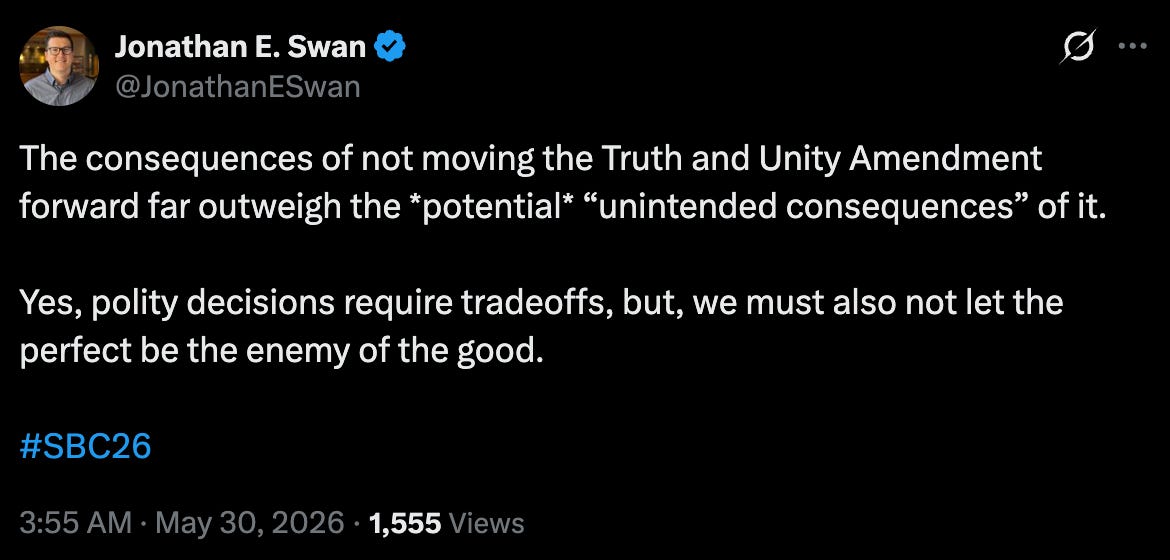
Some in favour of the amendment claim that the very future of the SBC depends on its passing and so insist that messengers “must get it done”. Here’s an example of that kind of thinking, from an executive editor for the Council for Biblical Manhood and Womanhood (CBMW):
Can you see how much he thinks is at stake?
The consequences of Dr Mohler’s amendment not being adopted far outweigh the *potential* “unintended consequences”—note the impressive use of both scare quotes and scare asterisks.
The good must not be sacrificed for the perfect.
Trade-offs must be made.
Here’s the thing though. Just days before this post, the same editor was joined by two of his CBMW colleagues on a podcast episode where, within the space of just a couple of minutes, they collaboratively and confidently asserted:
“We are not an egalitarian convention… the churches of the Southern Baptist Convention they’re overwhelmingly, convictionally complementarian, it’s written into our faith statement, and there is broad agreement about our faith statement… the [past] votes to remove churches with female pastors are always like 90%. I mean this is not something where Southern Baptists are backtracking on their views about complementarianism… I don’t think we’re being overrun by egalitarianism but I do think there are problems at the margins… I just hope that we can tighten everything back up… Egalitarianism is not a rampant problem in the SBC… the vast majority are conservative on this issue… it’s over 90%”
Likewise, here is what Dr Mohler himself said on a recent CBMW podcast:
“[This issue] hasn’t come up again and again and again in a crisis mode. It has come up in a polity, in a procedural way… The vast, vast, vast majority of Southern Baptists are absolutely unified on this issue. So we’re talking about something that is certainly something like 99% —I don’t have the math— but it’s so overwhelming in terms of the consensus in terms of the SBC on the question of complementarianism, on the question of whether or not the bible, the New Testament stipulates the order for the Christian ministry [that] we believe the office of the pastor is limited to men as qualified by Scripture
Now, I understand the need for denominational polity that seeks to secure orthodoxy and efficient process in the long term.
I get the need for good governance.
And I even agree with Jonathan Swan’s comments on that same podcast that “it only takes a handful of people in any body to fundamentally change an institution contrary to culture” (although, I don’t think he recognises he is wielding a double-edged sword. Because if it only takes a handful of egalitarians to fundamentally change the SBC in one direction, then it only takes a handful of misogynists to change it in the complete opposite direction and in doing so turn *potential* “unintended consequences” into *almost certain* “intended consequences”.).
But Dr Mohler said it himself. There is no theological crisis here. The SBC is overwhelmingly supportive of complementarian ministry practice. The disfellowshipping of key churches over this issue in recent years was done by an overwhelming majority. Affirmation of a male-only pastorate is written into the Baptist Faith and Message (the SBC’s primary statement of faith).
While I’m sure there would be consequences if the amendment is not passed (e.g. a less efficient disfellowshipping process, more time spent dealing with the matter from the convention floor) it seems Johnathan Swan and others’ warning about dire consequences is somewhat of an overstatement.
But the real problem is not that it’s an overstatement, but that it’s an overstatement which is neither harmless nor victimless..
See, look at it again (as representative of the broader discussion):
Firstly, note the double scare quotes/asterisks—*potential* “unintended consequences”—which implicitly suggest overreaction, perhaps even fear-mongering on the part of the critics.
Secondly, note his reference to acceptable “trade-offs”. in pursuit of the good.
And then, having noted both of those things, ask yourself these two questions:
Who will be the ones primarily bearing the weight of those *potential* “unintended consequences”?
Who are the ones being “traded-off”?
I can assure you the answer is not Jonathan Swan, any of his CBMW colleagues, Dr Mohler or any of the most vocal and prominent advocates of the amendment.
No.
The ones who will bear the primary burden of these *potential* “unintended consequences”, the ones in danger of being “traded off” are the complementarian women in vocational ministry in Southern Baptist churches and indeed in the wider evangelical complementarian ministry world.
It’s the woman on staff who is now too nervous to join her male colleagues on a collaborative podcast because Dr Mohler has announced that doing so would mean she is assuming the function of a pastor and she knows that if the amendment is going to be applied consistently (as it should be), her participation in that podcast could very well result in her church being disfellowshipped.
It’s the woman on staff whose years long faithful ministry to the children of her church has been done under the title of ‘Children’s Pastor’, and who is OK with her job title now changing to ‘Children’s Ministry Director’, but who also knows there is some level of disquiet amongst some in the congregation about how the name change doesn’t change the fact that they think she is still “functioning” as a pastor and that this is against the SBC constitution and that this could very well result in her church being disfellowshipped, or her losing her job.
It’s the woman on staff who has been actively involved in teaching Sunday School at her church for years now, but who gets pulled into the pastor’s office for a quiet chat one day because he’s heard on the grapevine that an individual from a neighbouring church plans to lodge a concern with the credentials committee because they believe her serving in this capacity is equivalent to her functioning as a pastor, and while he thinks it’s unlikely the credentials committee will find against them, he just doesn’t think it is in the best interests of the church to be in any kind of political spotlight right now and so she needs to stop serving in that capacity for the indefinite future and he’s sure she understands doesn’t she?
I could go on and on with more examples. But I think you get the point, right?
It’s the complementarian women in vocational ministry who will bear the brunt of the *potential* “unintended consequences”.
Their ministry, their service, their kingdom work, their belonging are the acceptable “trade-offs” in pursuit of this non-crisis, non-urgent, non-threatened political “good”.
It will be felt firstly and foremostly by complementarian women in ministry in Southern Baptist Churches. But it won’t stop there. It will extend to women in denominations and churches that take their complementarian lead from the SBC gatekeepers on this topic. Even just this week, I had two different men search out my LinkedIn profile and post screenshots of it on X in (thwarted) attempts to discredit my own very public, sustained and committed complementarian convictions.1
And so, I’m sorry to hear that the male advocates of this amendment are so very “tired of talking about this”. And yet, they aren’t the ones who will bear the brunt of the *potential* “unintended consequences” and the “trade-offs”
THIS 👇 is what this whole discussion feels like to so many of my complementarian sisters:

It feels like we’re standing in the middle of a minefield, unsure where we can step; uncertain about which path is safe; unclear about whether our next tentative movement is going to suddenly blow up in our (and our church’s) face; unable to know who exactly is actually writing, let alone consistently applying, the detailed rules of the “don’t step there because that’s functioning ‘such as’ a pastor” game.
It feels like we have to be constantly on guard, ever vigilant, always looking for any kind of danger, as we tentatively tiptoe through the complementarian minefield. And all the time, we’re being scrutinised by the very men who have the superpower to walk right through the same minefield with nary a care in the world that they might be blown to pieces at any moment.
And so that’s why it hurts so darn much when the same complementarian gatekeepers who are meant to be “for womanhood” in our churches casually dismiss us and/or our ministry as “trade-offs” they are willing to make.
It’s why it is so discouraging when they dismissively wave their metaphorical hand in the air about any *potential* “unintended consequences” being so much less significant than the consequence of them having to spend more time talking about this on the convention floor or having a somewhat less efficient disfellowshipping process or not being able to decisively declare eternal victory over their mortal enemies, the egalitarians.
Perhaps the amendment will pass. Perhaps it won’t.
But before complementarian women are told that any resulting collateral damage to them is simply the price of protecting complementarianism, they are entitled to ask a simple question: why should they be the ones expected to absorb the consequences of a proposal whose advocates themselves cannot seem to agree on where its boundaries lie or how—or indeed whether—those boundaries will be consistently applied?
Until that question can be answered, the concerns being raised are not distractions from the conversation. They are the conversation.
To their credit, both men responded graciously when I explained why their concerns were unfounded. However, their good-faith responses are certainly not representative of the usual hostility I receive from certain corners of the self-proclaimed complementarian camp.
I often reflect back on how I understood things when I was complementarian and part of an elder session, and your point about the minefield brought this thought to mind:
What complementarian men in leadership want is to have their relationship to God—as they see it— mirrored in women's relationship to them. Meaning: you deserve nothing, but because the one in authority over you is glorious, you are given mercy.
What does that mean in practice? You're meant to address the minefield through submission to authority, not through clear boundaries that let you make your own decisions. Women should act as though they are fully restricted by default, and let men/leaders give them permission, case-by-case, when and where they may step in the minefield, because those judgements are solely their responsibility as the protectors of the church's purity. Since God has placed them in authority, their benevolence should be trusted just as if you were trusting God himself.
So, men are never obligated to give women any place in the church, and when they do it should be cause for gratitude. Just like with God. And wow isn't that beautiful that they want to be like God to the women around them? Isn't it good that they want to be like God? 🐍
Dani, your title “Tiptoeing through the Complementarian Minefield” powerfully summarises the problem. But, as I commented on your earlier piece, the uncertainty is baked in.
The uncertainty has multiple causes.
In my view (though I guess not in yours), one of the causes is the lack of explicit Scriptural support for complementarianism. For example, there is no explicit command in Scripture from God to men, saying that men ought to lead women or to exercise authority over them.