

Picking a Path Through the Egalitarian Scorched Earth

In my past two posts (see here and here), I’ve been reflecting on some of the implications of the Southern Baptist Convention’s discussion about how/whether/if to legislate against female pastors. I’ve particularly lamented over how some complementarian men in ministry hurry to sacrifice their complementarian female coworkers on the altar of stamping out even the merest whiff of egalitarianism in the air.
As a complementarian woman in ministry, I’ve found pulling back that curtain neither comfortable nor pleasant. Not least because criticism of your own tribe is often interpreted as evidence that you belong to the other one.
I’m well aware that some US complementarian gatekeepers will have given themselves (and each other) celebratory pats on the back for having written me off some time ago as a functional egalitarian who is just playacting at complementarianism. And I’m sure they feel further confirmed in this by the fact that, over the last few weeks, a number of egalitarian commentators have enlisted some of my commentary into their critique.
But now, it’s time to turn the tables.

In my last post, I explained:
“…why it hurts so darn much when the same complementarian gatekeepers who are meant to be “for womanhood” in our churches casually dismiss us and/or our ministry as “trade-offs” they are willing to make.”
In this post, I want to turn the lens in the other direction and show how egalitarian gatekeepers—those who also position themselves as champions of women—end up doing the same thing.
Before I write anything else, let me be clear: I have dear friends who identify themselves as egalitarian. I’ve also had many charitable and profitable conversations (both online and offline) with egalitarian men and women alike over the years. I hope that continues.
And so what follows is not an attack on anyone but rather an attempt to show that egalitarians have proven themselves equally capable of rendering complementarian women invisible and expendable in pursuit of their own agenda.
Written Out of Our Own Story
My last two posts generated a number of comments from readers across the egalitarian and complementarian spectrum. (An aside: Friends, please forgive me for not having replied to any of them directly. It’s been a very busy couple of weeks, and I’ve had to prioritise my workload).
In those posts, I argued that a specific instance of (in my opinion) poorly understood, selectively executed, and inconsistently applied complementarian theology would almost certainly result in, well, poorly understood, selectively executed and inconsistently applied complementarian practice.
As they responded to that argument, a particular theme emerged from my egalitarian readers. Here are some examples from their comments:
Uncertainty is baked into complementarianism…
Dani, your title “Tiptoeing through the Complementarian Minefield” powerfully summarises the problem. But, as I commented on your earlier piece, the uncertainty is baked in.
Totally agree that the uncertainty is baked in…
I hope this doesn’t come across as snarky or combative. But, to me, the irony of what you shared is that it’s an incredibly strong argument against complementarianism itself. The minefield you described so well has existed and will continue to exist whether or not this SBC amendment passes. And it’s this minefield that makes the whole thing untenable.
Fantastic article, I've solved this issue by becoming egalitarian
I’m genuinely thankful for these individuals’ engagement.
And yet, here’s the thing:
Any time a complementarian points out an example of inconsistent or problematic complementarian theology or practice, a predictable egalitarian response is to immediately insist that the problem obviously lies with complementarianism itself.
While they tend to have no problem critiquing an individual element of poorly considered or inconsistently applied egalitarianism without tearing down their entire system, egalitarian commentators can rarely resist the opportunity to turn any critique of complementarianism into a zero-sum game. Or to switch up my metaphors, they are ever poised to throw the baby out with the bathwater.
This is frustrating. It can also have the exact opposite effect to what they intend, because their scorched-earth approach often encourages the poorly considered complementarian practitioner to double down (and, often, at the expense of women within the system).
But the part of this approach that I really struggle with is the way it usually writes complementarian women like me out of our own story. Why? Well, because those of us with a flourishing ministry, engaged in thriving service, and with the respect and support of our male colleagues, complicate their argument that the system is intrinsically incomprehensible and irredeemably problematic.
Our existence poses a real problem to a narrative that regards harm to women as the inevitable outcome of complementarianism.
At first glance, the comments above (and the broader discourse they represent) may seem rather innocuous. After all, none of those egalitarian readers is questioning whether complementarian women have the right to minister.
And yet, by making complementarianism itself the problem, they inevitably make the existence of complementarian women who are flourishing in ministry—let alone the existence of others who are flourishing as a result of their ministry—an inconvenient data point.
Here’s a recent and more localised (to me) example of just that. It was posted a few days ago by an egalitarian commentator, following the announcement that the current principal of the (complementarian) theological seminary I studied at here in Sydney, Australia, will retire at the end of 2027.
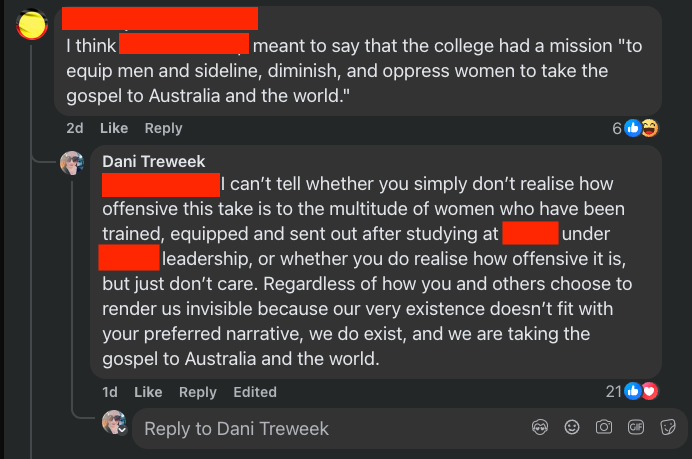
This is the natural endpoint of the argument that uncertainty is baked into complementarianism, that the whole system is untenable, and that the way to solve poorly conceived and executed complementarianism is to give it up altogether and become egalitarian instead.
When that’s the argument being made, how can the existence, let alone flourishing well-being and ministry of complementarian women, be accounted for?
The answer is, not easily.
One approach is to make us the exception to the rule. But the more exceptions to the rule there are—and in a complementarian context such as mine in Sydney, there are a lot—the harder it becomes to maintain that the rule itself explains reality. Eventually that approach wears thin or becomes untenable, and it is more expedient to just pretend we don’t exist at all.
When that happens—and it often does—complementarian women find themselves erased from their own story by the same people who claim to be the true advocates of women.
At best, we’re diminished. At worst, we’re erased.
Sound familiar?
Patronised Out of Our Own Convictions
And yet this is not the full story of how complementarian women are diminished by many egalitarian commentators. There is another response that appears just as frequently. And it’s one I find even more patronising.
If the first move treats us as if our experiences—even our existences—don’t really matter, the second treats us as though our convictions don’t really count.
Here’s a comment made on one of my recent posts that represents a kinder, subtler, but no less apparent version of this tactic:
Hi Dani, I’m a reader with a long history in Sydney Anglican Church, Moore College and complementarianism - who has changed her mind after checking different exegetical approaches to the 3 (only 3) contested passages and reconsidering the whole Bible story. Feels like a window has been opened. I’m sure you’ll check out Preston Sprinkle’s recent Genesis to Junia; he took a slow careful path to the same conclusion. Come join us!!!
I have no doubt that this commentator wrote in good faith and with good intentions. (And for the record, I have read Preston’s recent book). And yet, notice the narrative clearly at play in it.
Complementarians stubbornly hang their hats on just three isolated passages in the whole of Scripture. But all it would take for them to come to their senses—especially the women—is checking out different (i.e., egalitarian) readings of those passages. Once they’ve been willing to do that… FREEDOM!
Many egalitarians refuse to recognise complementarian women as serious theological interlocutors who have weighed the arguments and yet reached a different conclusion. Instead, we become women who simply haven’t quite caught up yet.
Indeed, a decade or so ago, when I first entered the public fray on this topic, a prominent egalitarian advocate joked on Twitter that, as a complementarian, I was clearly suffering from an acute case of Stockholm Syndrome. He’s since apologised. We’re friendly with each other. And yet, the same refrain continues as a standard egalitarian tactic.
After all, haven’t the relevant biblical texts been explained? Haven’t the arguments been settled? Hasn’t complementarianism already been decisively refuted?
Australian egalitarian advocate (and Sydney Anglican critic) Kevin Giles certainly seems to think so. Here is a quote from one of his books that was recently posted to much acclaim by an Australian egalitarian lobby group.
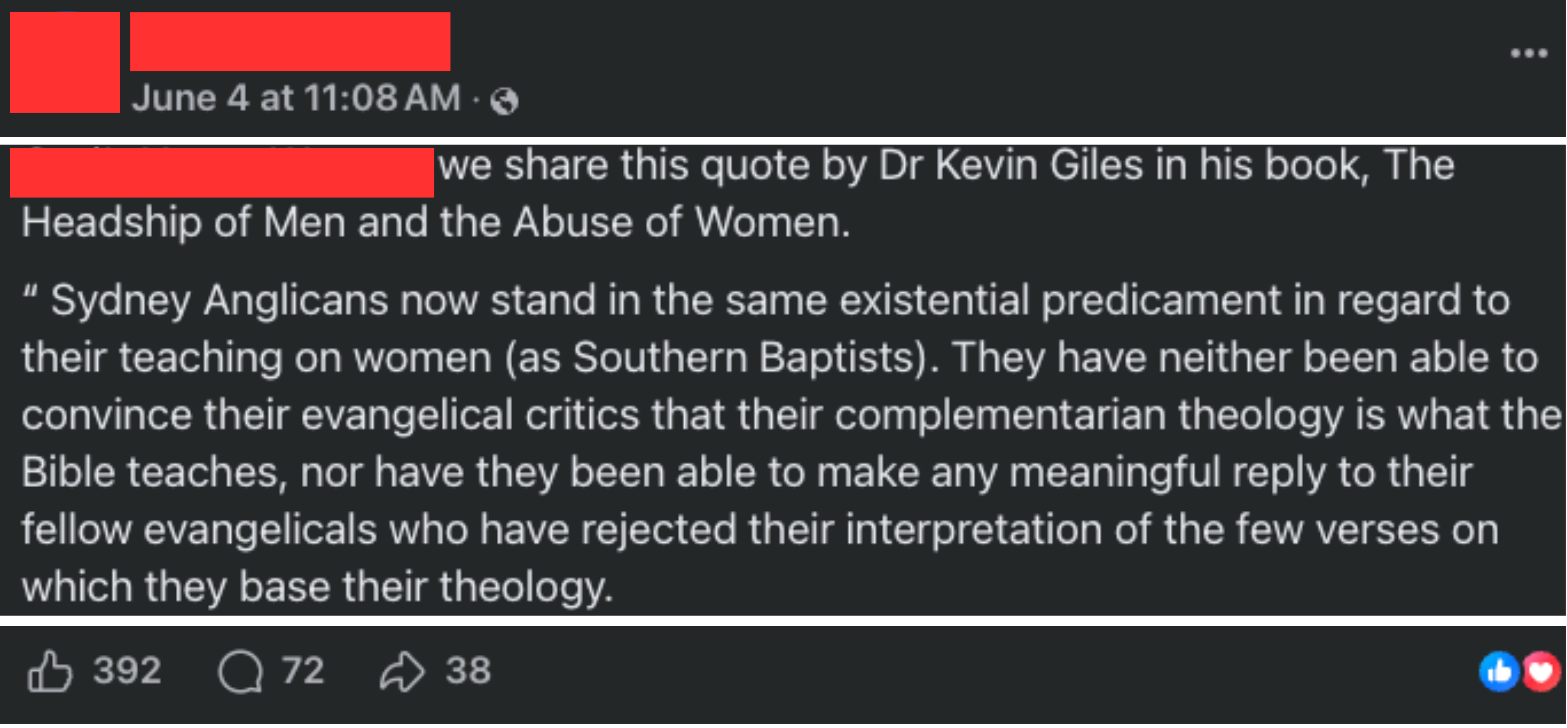
Of course, Kevin Giles is perfectly entitled to remain unconvinced by complementarian arguments. But there is a world of difference between finding an argument unconvincing and pretending no meaningful argument has actually been made.
For decades, complementarian scholars, pastors, and theologians have produced extensive exegetical, theological, historical, and pastoral responses to egalitarian arguments. In my part of the world this has included numerous Sydney Anglican Doctrine Commission reports, written by leading evangelical scholars; the academic work of preeminent Australian complementarian scholars such as Dr Claire Smith, Dr Lionel Windsor, and Dr Andrew Leslie; the theologically, biblically and pastorally astute writing and ministry of complementarian women such as Jane Tooher, Clare Deeves, Veronica Hoyt and, at the risk of being presumptuous, myself; a multitude of thought-provoking and challenging talks, seminars, and workshops given by a vast array of intelligent and thoughtful speakers as part of the Priscilla and Aquila Centre, and more.
Kevin Giles and the 392 people who liked his quote may disagree with the arguments made by those individuals in those resources. But to casually dismiss them as though they do not constitute meaningful engagement is not a serious argument. It is simply a lazy refusal to take their interlocutors seriously.
So too is the claim that complementarians base their entire theology on just three superficial proof-texts from Scripture.
Go watch these two talks from the Priscilla and Aquila resource library; read Claire Smith’s excellent book; pick up a copy of the latest edition of Recovering Biblical Manhood and Womanhood; read my chapter in this new title. Do all of that, noting down every part you disagree with and why you disagree with it, and then come back, look me in the eye and tell me that complementarian theology rides on just three contested passages of the Bible.
This claim, too, is unserious. It does not engage complementarian theology in good faith, but conveniently dismisses it. In doing so, it reveals just how difficult it is for many egalitarians to imagine that thoughtful, biblically serious Christians—and especially women—might weigh the same evidence and arrive at different conclusions to them.
The Women in the Way
My purpose in this post has not been to rehash the complementarian-egalitarian debate. Goodness knows enough ink has been spilled on that elsewhere, and undoubtedly more is yet to come. Instead, I’ve wanted to complete this three-part series by demonstrating how easy it is for egalitarians to also reckon complementarian women expendable.
We’re treated as exceptions or as inconvenient data points to be done away with. Our carefully considered convictions are casually dismissed by the claim that we simply haven’t considered or understood the arguments yet. Our ministry is discounted, our theological judgements are patronised, and our existence is written out of the story.
Too many complementarian gatekeepers consign us to precariously tiptoe through the complementarian minefield they’ve created as an acceptable “trade-off” in their war against egalitarianism.
Too many egalitarian critics are so wedded to the utter bankruptcy of complementarianism that they render invisible women who complicate their case.
One treats us as acceptable collateral damage.
The other treats us as a problem to be explained away.
Both insist they are acting for the good of women. And yet both also seem remarkably willing to disregard the real-life women who get in the way of the story they want to tell.
I get a bit frustrated when I hear egalitarians act like we just haven't done enough research as complementarian women. I grew up under a "complementarianism" that was more sexism hiding under the umbrella than anything else. My father believed he could marry me to whomever he wanted (with or without my consent) and also that, as his daughter, I belonged to him (in his words) "like slaves belong to their master." So when I left home (I had to flee, leave the state, and go into hiding), I was very keen on becoming egalitarian. I don't think it's an overstatement to say I felt like my faith hinged quite heavily on becoming egalitarian. And in pursuit of that, I read every egalitarian book on the topic that I could get my hands on. And I talked to every egalitarian I could talk to. And then I studied the Scriptures. And then more books. And more conversations. And more Bible study. And to my great dismay, I ended up a complementarian. I didn't end up there because I wanted to. I didn't just read my "side" and say, "Yeah that sounds right." I was desperately trying to escape my "side". I was heavily heavily heavily biased towards believing the egalitarian side. But based on their own best arguments, I just could not get there. Fortunately my studies along the way gave me a complementarianism that is, if anything, entirely anti-sexist and a total opposite to my parent's beliefs. And now my faith is stronger than ever and I'm a leader in my church. But damn, its irritating when they act like if we just read this or that book, we'd understand. Because I've read most of them. Every one that was recommended to me certainly. And they, and my own studies (and to date not a single complementarian book) made me a settled complementarian (still a little begrudgingly at times 😅).
As an egalitarian, let me say thanks for this challenge. I completely agree that it’s absurd to claim complementarianism is only held by people who haven’t studied enough yet. I just published an article responding to Al Mohler claiming egalitarianism is just liberalism caving to culture without any biblical or theological consideration. That’s wrong to say of the “other side,” regardless of who says it.
If a farmer goes out into two fields to sow daisy and tulip seeds, and if one field produces hundreds of each flower growing together, while the other field produces hundreds of daisies, but just a few tulips, it is good and right to question why the second field wasn’t hospitable to tulips. That’s not to say the tulips that *did* grow in that field are inconvenient data points. The tulips are the goal, just like the daisies. We just want more of them.